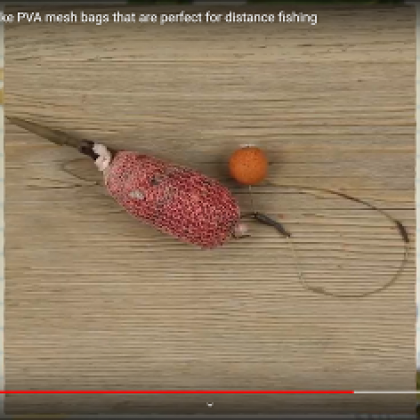
I love the hooking potential and the anti-tangle properties of in
line leads however, they do have their drawbacks, i.e. in the unfortunate event of a break off then a fish could potentially be trailing a long length of line including any leaders that may have been used.
After seeing one of Steve Fantauzzi’s similar rigs which incorporated the use of a large bead and drilling the front of the lead out slightly, I was impressed with the idea but wanted to simplify it a little.
I simply used a flexi-ring swivel spliced onto the leadcore via the larger ring. Then using another flexi-ring swivel I simply slide it onto the leadcore helicopter style. The lead is then attached to the leadcore by pushing the swivel into the end of the lead and running it around the outside of the lead (normal drop off style). However I found that the swivel was being gripped too tightly for the lead to drop off easily, so I simply cut the plastic insert back slightly (see note) and placed an ESP Heli Bead onto the eye of the swivel and this gives just the right amount of resistance to prick the fish without being too tight.
It goes without saying that in the unfortunate event of a break off the less the fish is towing around the better, to that end I prefer to use a helicopter rig as theoretically all the fish should be left to tow around is the hooklink. I say theoretically as we can never be certain of all the underwater features/foliage that may hinder the hooklink from coming free. However in my eyes it is certainly a damn sight safer than the hooklink being tied directly onto the end of the mainline or leader etc, leaving the fish potentially towing 100+ yards of line or braid, whether the lead comes off or not.
There is no mistaking the effectiveness of the recently popular ‘Chod’ type rigs and the helicopter is a rig I have been using since I left the dark arts of matchfishing around 17 years ago. But like all good things it does have its drawbacks, and one of those is in weedy waters, where ideally we want the lead to drop off very early on to give us a greater chance of landing our quarry. There are some recent ‘ready made’ rigs from the tackle manufacturers that do just that, but they also look like most ‘ready made’ rigs and in my opinion are way too obvious and obtrusive with bulky parts. So to that end a few friends of mine and I set about trying our own version with a less obvious profile (and a tidier one too).
I’ve been playing around with PVA for some time now, and here I’m going to show two different ways of making pva bags for use. The first method you will see is using a PVA tube, ideal for making a required bag size with little waste, tying both ends of the bag. The second method is still using the PVA tube but this time without any knots at all, instead I’ve been using a heat sealer to seal and cut the bag. Producing minimalistic waste and no reliance on knot strength. In both instances I am demonstrating the bags using maggots as my ground bait.
The location of carp is not such an easy task when we move into the colder months. My time on the bank tends to be shorter, fishing time is at a premium with the shorter days, and time for fish spotting is limited.
Rolling and leaping carp are rare, as are the tell tale feeding bubbles so often seen when the fish are more active. They are less likely to be actively moving around the lake seeking food, so one answer is to take it to them. When I’m winterfishing at least one of my rods will be roaming. Every half to one hour I will recast to a different area of the swim? I like PVA mesh tube as it breaks down very quickly and releases the bait. Attaching a small bag of crumbed boile or Quest Maximum Action Pellets to the hook increases the attraction without feeding the carp too much. This will often stimulate a feeding response and put that bonus wintercarp on the bank.
In the last year rather than stick to one main syndicate water I have fished lots of waters both in the UK and France.Most of these waters were completely new to me, many I had not even seen before I started fishing.Of course I could write about how I used watercraft, searching for gravel spots, weed beds, bars, drop offs, gulleys, bottlenecks and all the usual elements that go into choosing our swim and the places we fish in them.I’m going to take that as read though and concentrate on feeding. When I approach a new water; unless I know for certain the fish are feeding heavily, and fish are getting caught, it’s unlikely that I will start by creating large beds of particles or boilies from the start. (more…)
One of my favourite methods of carpfishing is using PVA bags. We all know it can be an absolutely deadly method of catching carp but even more so when used at long range where the carp have rarely come across this presentation. The first time I tried to cast a PVAbag a long way, the bag didn’t stand up to the job and I wasn’t confident with the overall result. So I decided to set about making a rig which would cast well and not tangle. The rig below is what I now use for all my long range bag work, it’s simple to construct, casts well, tangle free and prevents the bag coming away from the lead on impact with the water.